
We perform BATTERY - EKG testing and analysis at the client's site, with our portable testing instrumentation. Typically, testing is performed annually. As such, BATTERY-EKG is a sampled test, in contrast to a continuous test, in which a monitoring system is permanently connected to the battery.
The advantage of a continuous test is the ability to detect failures (assuming, of course, that the test gives accurate capacity results) that might occur between sampled tests. However, from years of experience gained in observations of batteries in standby power systems, the likelihood of such "unpredictable" failures is rare less than 1% of the total number of failures! Reliably detecting all such failures would require instrumenting every battery string with continuous monitors, at a considerable expense, and the effort needed to interpret the data from the tests would be overwhelming.
The testing interval we use depends on battery age and condition, and is in compliance with IEEE standards. In accordance with IEEE Standards Document 1188-1996 ("IEEE Recommended Practice for Maintenance, Testing, and Replacement of Valve-Regulated Lead-Acid Batteries for Stationary Applications") annual testing is recommended, supplemented by tests every 6 months when the battery shows signs of degradation (less than 90% of rated capacity, or over 10% capacity loss between tests). This interval is sufficient from the standpoint of practicality, because during a short time period, the decline in battery condition usually follows a predictable course.
The most cost-effective approach to testing is to perform relatively inexpensive sampling tests, which will detect over 99% of all battery failures, in time for corrective action. The most critical (or inaccessible) sites could be equipped with continuous monitoring systems. For such sites, Channel D is developing a continuous monitoring system, providing all the benefits of our BATTERY-EKG monitoring and analysis technology.
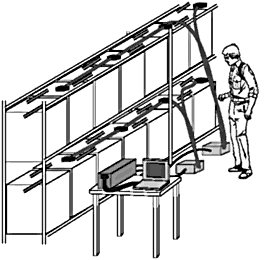
Setup of Battery-EKG. The main unit consists of a laptop computer and interface. The interface connects to twelve battery transducers (eight are shown), each of which conditions and processes signals from two cells. Flooded batteries are depicted; we also test valve-regulated batteries in central offices, huts, and CEVs. Multiple testing units expedite the testing of several battery strings per site.